

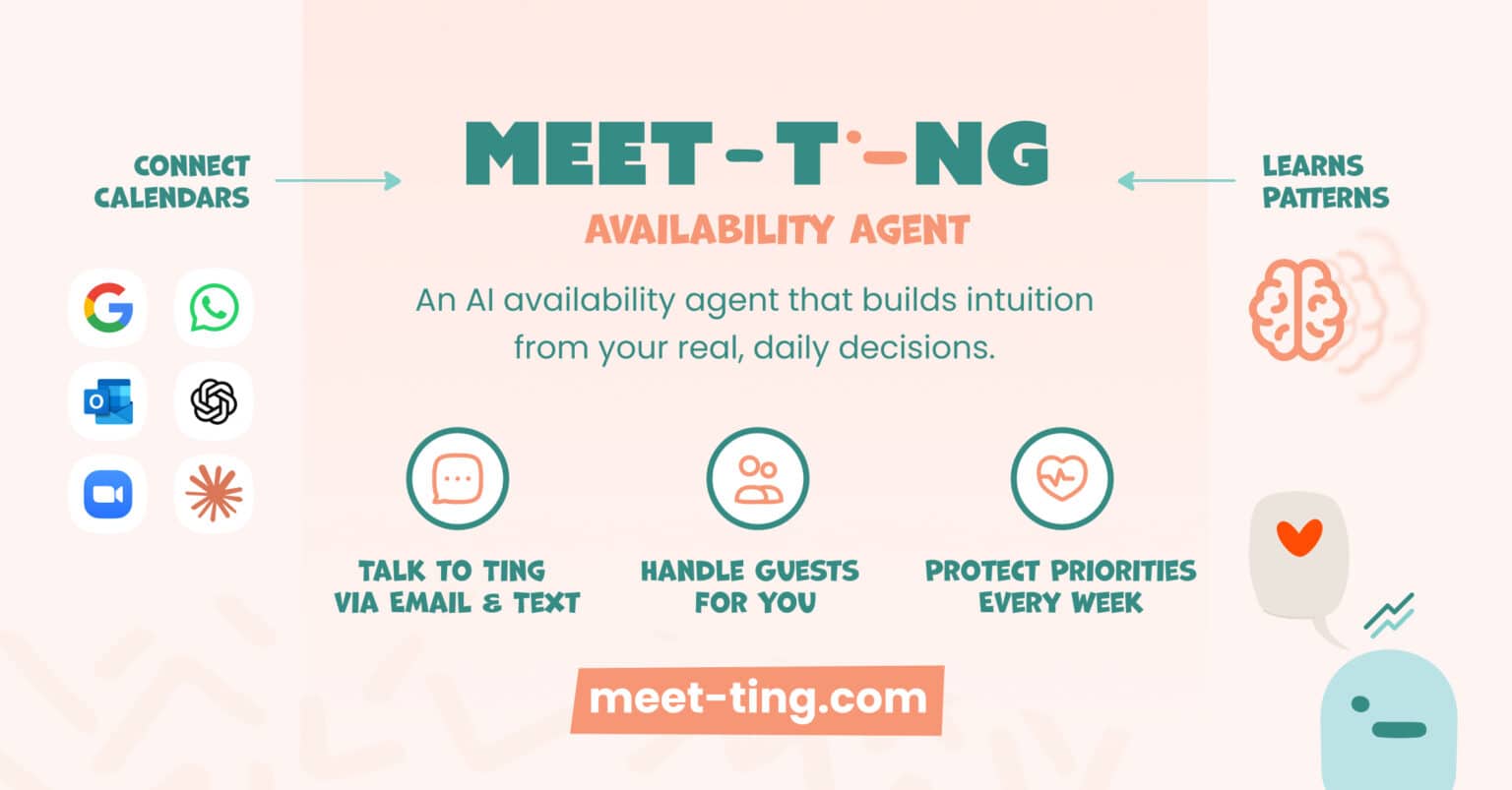
A London-based startup backed by Google is testing how far people are willing to trust artificial intelligence with one of their most personal productivity tools: their calendar. Meet-Ting, often shortened to Ting, is experimenting with AI agents that manage scheduling autonomously by learning user behavior rather than relying on predefined rules.
The company’s approach challenges traditional calendar assistants by removing dashboards, booking links, and manual configuration entirely.
How Meet-Ting’s AI Availability Agent Works
Unlike conventional scheduling tools, Meet-Ting operates directly inside email and messaging threads. Users simply copy or message the AI agent, which then takes over coordination with other parties.
The system works across:
- SMS
- Messaging platforms such as WhatsApp
Instead of asking users to set rules or availability windows, Ting observes decisions over time. Each interaction helps the system learn preferences around:
- preferred meeting times
- urgency thresholds
- relationships and hierarchy
- conflict resolution patterns
Meet-Ting describes this as teaching the AI judgment rather than instructions.
Learning From Behavior, Not Configuration
Meet-Ting’s core idea is that calendars reflect priorities, not just availability. By tracking which meetings users accept, postpone, or decline, the agent gradually builds a working model of what matters most.
According to the company, this allows the system to:
- proactively suggest rescheduling
- follow up on no-shows
- prepare contextual information ahead of meetings
During a six-month beta period, some users reportedly booked up to 20 meetings per month entirely through the agent, including high-stakes situations such as investor meetings and job interviews.
Meet-Ting says this level of usage suggests growing trust in AI-managed scheduling for important outcomes.
Weekly Check-Ins and Ongoing Adjustment
Rather than operating silently, the availability agent performs weekly check-ins with users. These reviews compare the current calendar against stated goals, allowing the system to adjust its behavior if priorities shift.
This feedback loop is designed to prevent drift, ensuring the agent remains aligned with evolving personal and professional needs.
Designed for an Agent-First Work Environment
Meet-Ting is also betting on a future where work conversations increasingly happen inside large language model (LLM) environments rather than standalone productivity apps.
To support this, the agent is designed to operate natively across:
- email platforms
- messaging services
- AI-driven chat interfaces
By staying inside these communication channels, Ting can capture contextual signals that traditional calendars miss, such as tone, negotiation flow, and conversational nuance.
The company says this data remains private and user-specific, used only to train individual models rather than shared systems.
Adoption and Early Traction
Meet-Ting reports several thousand users signed up so far, with roughly half actively interacting with the agent. Growth has been described as steady rather than explosive, reflecting the cautious nature of delegating control over schedules.
Dan Bulteel, co-founder of Meet-Ting, frames the challenge clearly:
“The question isn’t whether AI can book meetings — it’s whether people will let it.” TechCrunch
According to Bulteel, delegation happens only once the system demonstrates a real understanding of what users value.